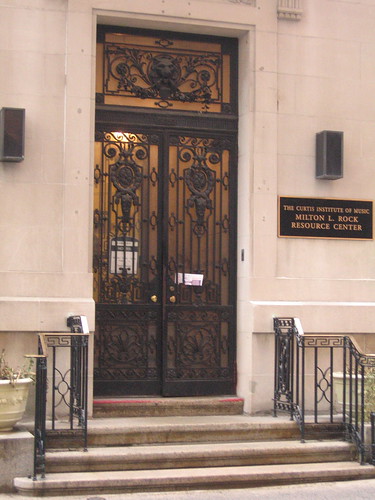
The Curtis Institute of Music is one of the most respected conservatories in the world, instructing about 160 scholarship students annually in a performance-focused environment. The John de Lancie Library is located in the Milton L. Rock Resource Center, which is located across the street from the institute on Mozart Place near Rittenhouse Square in Center City Philadelphia.
The library houses more than 80,000 music scores, books, and recordings in the four floors of a 1908 townhouse. The cramped confines of the beautiful building pose space challenges for their small professional staff. Planned renovations to the basement and the eventual relocation of the orchestra parts library and instrument collection to a new facility should give the de Lancie Library room to grow.
Head librarian Elizabeth Walker says that their collection is almost entirely scores and recordings for student use; very little research materials are used. For the de Lancie Library, there are 3 professional librarians, one quarter-time archivist, and one-and-one-half support staff positions. All of the Curtis librarians are performing musicians with cataloguing knowledge in at least three languages. The three orchestra staff members, whose library is located on the top floor of the building, equal about three-quarters of one full-time position. The orchestra library staff also rent all the music for Curtis’ students.
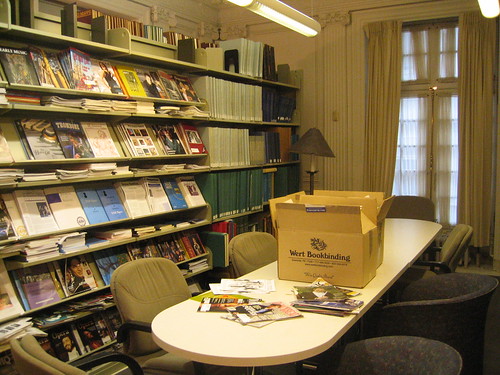
The first floor of Curtis’ library mainly consists of a periodicals reading room. There are interesting donated artifacts in this room, like death masks and hand casts of famous composers and a beautiful, giant Latin Gradual from Spain, dating from the latter half of the 16th century.
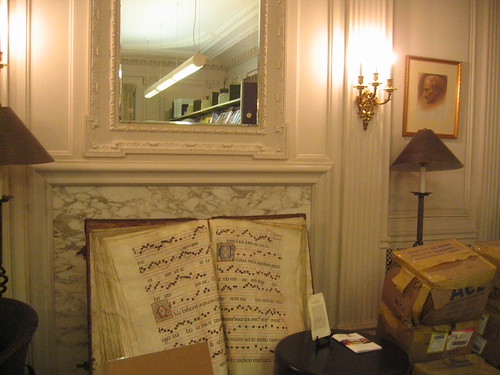
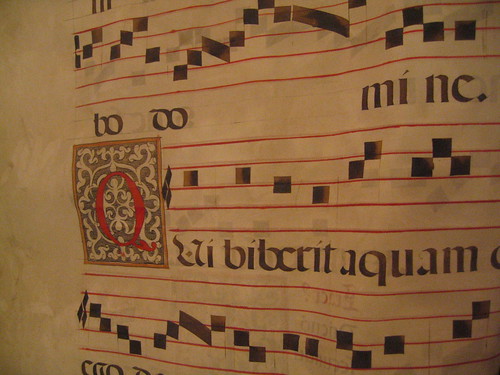
It was a bit jarring to see such a thing just out in the open like that, surrounded by boxes. It is the second of a 4 volume set, illustrating the music of the propers of masses that fall between the first Sunday of Lent and Palm Sunday. The parchment folio stands about three feet tall. A closer look:
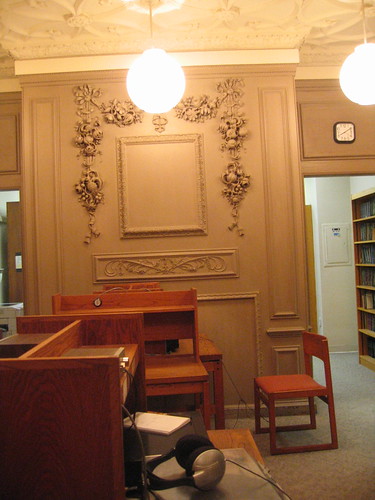
On the second floor there is a rather beautiful hurdy gurdy as well that was donated by a former student. The second floor accommodates students’ audio and visual needs, with microform readers, Internet access, and listening carrels with turntables, cassettes, CD and CDR capabilities. Students can access the library’s proprietary catalog, the Rock Online Catalog (ROC), at computers on this floor as well. Currently 90 percent of the Institute’s materials are catalogued in ROC, including all extant recordings of Curtis performances. The library also provides access to a growing number of music-related electronic databases.
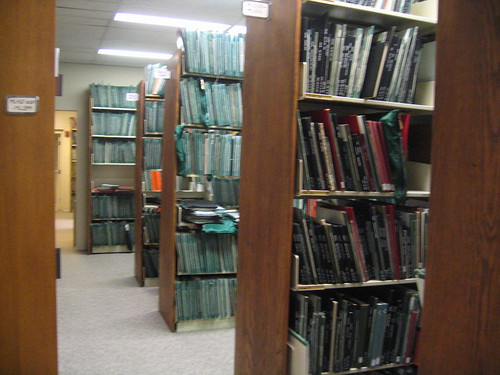
There are also stacks of recordings, primarily on vinyl, but some other media as well including reel-to-reel tape.
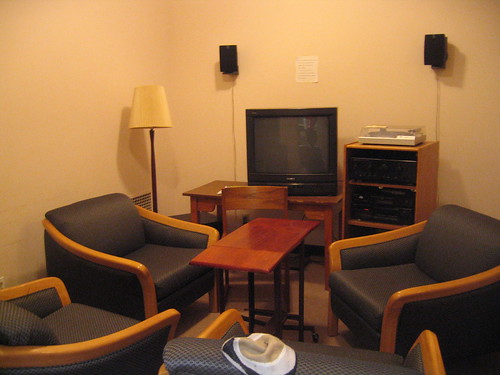
Also on the second floor is an enclosed listening room for groups to watch and listen to performances.
Although the top floor was closed, there is an instrument lending library for the Curtis students. Eighty string instruments, ranging from 17th century Cremonese craftsmanship to modern American instruments are housed in a climate-controlled room. A wide selection of woodwind and brass instruments are also available there.
The library at the Curtis Institute of Music is one of a score of amazing special libraries tucked away in the streets of Philadelphia. One can live their whole life in the city and not know that such places even exist. As a library student and lover of this fair city, I’ve been making it my business to visit a lot of these libraries and check out their collections. There are a lot of treasures in this town if you take the time to look.
This particular visit (and this blog entry) is for an assignment for my Music Librarianship and Bibliography class, via the GSLiS at University of Illinois Urbana-Champaign. I’m taking this class through a consortium as a Fasttrack MLIS student at the University of Pittsburgh. Come spring, I’ll have my degree.
Labels: curtis, library, mlis, orchestra, Philadelphia


